

As we stand at the threshold of a promising solar-powered future in South Africa, we are confronted with a multitude of challenges that threaten to hinder the industry’s growth.
A severe shortage of skilled professionals, inadequate safety standards, and regulatory hurdles put entire communities at risk.
Financing barriers, inadequate industry standards, and grid integration issues also pose significant obstacles.
Furthermore, policy and regulatory framework gaps stall growth and hinder investment.
It is clear that we have our work cut out for us, but by tackling these challenges head-on, we can tap the full potential of solar energy in South Africa.
Lack of Skilled Professionals
As we endeavour to harness the power of solar energy, a critical obstacle stands in our way: a severe shortage of skilled professionals, particularly electricians, which is crippling the growth of the solar industry in South Africa.
This shortage is staggering, with the industry requiring an additional 10,000 to 15,000 skilled professionals to meet the growing demand for solar energy solutions.
The failure of the education system to keep pace with new technology means that even formally educated individuals require training to enter the industry. For instance, many graduates lack the practical skills to design and install solar panels, highlighting the need for industry-specific training.
It’s clear that industry-led training programmes alone are insufficient to address the shortage. What we need are government-backed education initiatives and training incentives to attract and retain skilled professionals.
By providing the necessary support, we can create a workforce capable of driving the solar industry forward. For example, the government could establish vocational training centres that provide apprenticeships in solar panel installation and maintenance.
Furthermore, offering tax incentives to companies that invest in employee training programmes could also help address the shortage.
It’s time for us to take action and invest in our people, ensuring that we’ve the skills and expertise to tap the full potential of solar energy in South Africa.
Safety Risks and Regulation Gaps
The alarming lack of safety standards and regulatory oversight in the solar industry poses a significant threat to entire communities, undermining confidence in this renewable energy source.
Electrical fires, often preventable, remain a major concern.
The root of the problem lies in inadequate worker training, which can lead to faulty installations or inadequate maintenance, resulting in devastating blazes that put lives at risk and cause property damage.
For instance, a faulty DC isolator or a poorly installed inverter can spark a fire.
To address this critical issue, it’s essential to provide comprehensive training programs for solar installers, ensuring they possess the necessary skills and knowledge to guarantee safe installations.
Stricter regulations and enforcement are also crucial to preventing these avoidable tragedies.
Inadequate Industry Standards
What constitutes a ‘good enough‘ solar panel, and how can we trust that manufacturers are holding themselves to high standards when there’s no industry-wide benchmark to uphold?
We’ve all heard horror stories about subpar solar panels that don’t deliver on their promised performance. This lack of standardization puts consumers at risk of investing in inferior products, which can be costly and inefficient. For instance, a solar panel with a low energy output can lead to higher electricity bills and a longer payback period.
To ensure the quality of solar panels, robust certification frameworks and compliance protocols are essential. Clear standards for performance and durability are critical, with manufacturers being held to specific benchmarks for energy output, lifespan, and environmental resilience.
For example, a solar panel should be able to withstand extreme temperatures and humidity levels. Regular testing and inspection by independent bodies should be conducted to ensure compliance with standards. Manufacturers should be transparent about their materials, production processes, and quality control measures.
This transparency is vital in building trust with consumers and ensuring accountability.
There should be consequences for manufacturers that fail to meet industry standards. Additionally, the industry should encourage innovation and continuous improvement to drive up standards and performance.
This can be achieved by incentivising manufacturers to invest in research and development, leading to more efficient and sustainable solar panels.
Financing Barriers to Adoption
Despite the growing popularity of solar energy, financing barriers persist as a significant obstacle to widespread adoption, largely due to high upfront costs and limited access to capital, which hinders many individuals and businesses from investing in solar systems.
Traditional lending institutions frequently perceive solar projects as high-risk investments, resulting in limited financing options.
However, innovative financing models, such as solar leasing and power purchase agreements (PPAs), enable individuals and businesses to install solar systems without incurring upfront costs, thereby making solar energy more accessible.
Governments and organizations have introduced various financial incentives, grants, and subsidies to facilitate financing opportunities for solar energy projects, particularly for small and medium-sized enterprises (SMEs) and low-income communities.
Partnerships between financial institutions, solar developers, and government bodies have been formed to create tailored financing options, expanding access to solar financing for a broader range of businesses and communities.
Grid Integration and Infrastructure
As we shift our focus to grid integration and infrastructure, we’re faced with some critical challenges.
We’re talking about the limitations of our current grid capacity, the need for transmission line upgrades, and the strains on our distribution networks.
These are the hurdles we need to overcome to guarantee that solar power can be efficiently and reliably integrated into our energy system.
Grid Capacity Constraints
The integration of solar power into the grid is hindered by the outdated infrastructure, which urgently requires upgrades to accommodate the influx of intermittent renewable energy sources. The current grid capacity constraints pose a significant obstacle to harnessing the full potential of solar energy in South Africa. If left unaddressed, this issue will result in load shedding, economic losses, and a power supply gap that cost the country R184 billion in 2023.
To overcome these challenges, it’s essential to upgrade the grid infrastructure to accommodate intermittent renewable energy sources, such as solar power, thereby ensuring a stable energy supply.
Implement smart grids and energy storage systems, like advanced battery storage, to stabilize and reinforce a reliable energy supply.
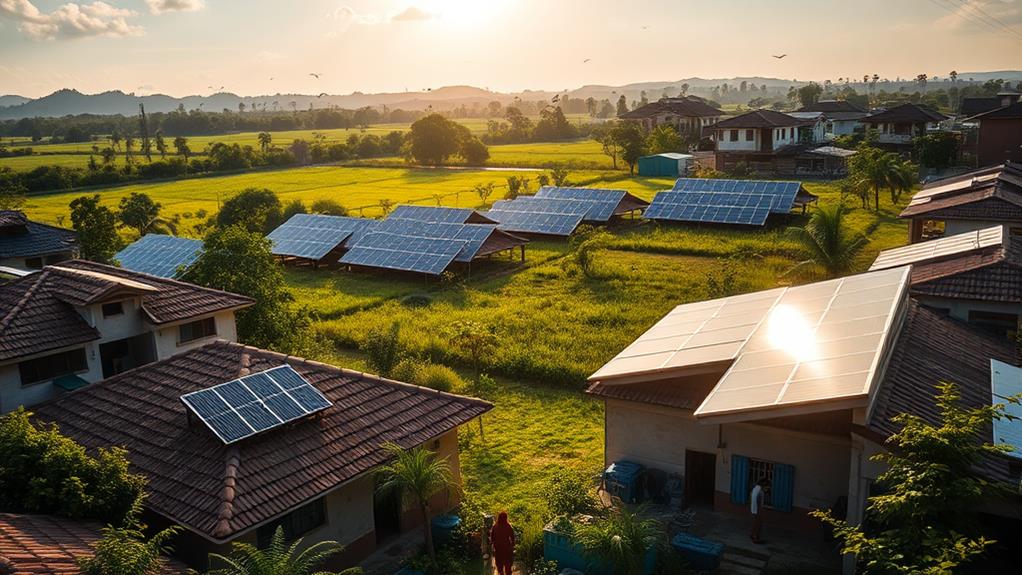
Develop decentralized energy systems, such as mini-grids and micro-grids, to mitigate grid capacity constraints, particularly in rural areas.
Improve energy efficiency and grid resilience to minimize the impact of peak demand periods, for instance, by using energy-efficient appliances and smart home devices.
Invest in grid modernization and infrastructure development, such as advanced weather forecasting systems, to enable the seamless integration of renewable energy sources into the grid.
Transmission Line Upgrades
Upgrading transmission lines is crucial for the efficient transmission of solar power over long distances. It’s essential to replace outdated infrastructure with advanced, high-voltage transmission lines that can handle the variable output of renewable energy sources.
This is because old technology is prone to power outages and wasted potential.
Modernising infrastructure is vital to unlock the full potential of solar energy. By investing in advanced transmission lines, such as those using high-temperature, low-sag conductors, we can provide a reliable and efficient flow of energy from the source to the consumer.
This, in turn, reduces the likelihood of power outages, lowers energy costs, and significantly decreases our carbon footprint. For instance, the UK’s National Grid can benefit from upgrading its transmission lines to accommodate the increasing share of renewable energy in the energy mix.
By modernising our infrastructure, we’ll take a pivotal step towards a sustainable energy future.
This is a critical step in reducing our reliance on fossil fuels and mitigating climate change.
Distribution Network Strains
Upgrading transmission lines is only half the battle; distributing solar power efficiently poses a significant challenge to our distribution networks. The issue extends beyond transmitting power from the solar farm to the grid, as we must also ensure it reaches those who need it most. This is where the complexities arise.
Our distribution networks, initially designed to handle consistent energy flows, struggle to cope with the fluctuating nature of solar power, which compromises grid resilience.
The key challenges we face include:
Managing peak demand during hot summer afternoons when air conditioning units are in high use, thereby straining the grid
Mitigating the impact of weather conditions on solar power output variability
Upgrading infrastructure to accommodate the two-way flow of energy, facilitating the integration of solar power into the grid
Ensuring the grid can handle increased voltage fluctuations, thereby maintaining a stable power supply
Integrating energy storage solutions, such as batteries, to stabilise the grid during periods of high demand, reducing the likelihood of power outages
To provide a reliable and efficient supply of solar power, it’s essential that we strengthen our distribution networks. By developing innovative solutions to these challenges, we can create a more sustainable energy future.
Policy and Regulatory Hurdles
As we turn our attention to policy and regulatory hurdles, we’re faced with two major obstacles that are hindering the growth of the solar industry.
Licensing delays are a significant pain point, causing frustrating setbacks for projects and stifling innovation.
Meanwhile, an unclear policy framework is leaving many of us wondering what’s next and how to move forward.
Licensing Delays Hindering Growth
The solar industry in South Africa is stalled, with licensing delays of up to 18 months hindering the development of solar projects. This bottleneck is primarily caused by the prolonged approval process of the National Energy Regulator of South Africa (NERSA), which has severe implications for the industry’s growth.
The absence of a clear and streamlined regulatory framework is a significant deterrent for investors and developers, as it leads to bureaucratic inefficiencies and red tape that slow down the permitting process. This, in turn, discourages investment and stifles the growth of the solar industry in South Africa.
To address this issue, a one-stop-shop for regulatory approvals is essential to reduce delays and encourage investment. The current energy supply gap, largely attributed to these delays, is estimated to be costing the South African economy approximately R23 billion per year.
A regulatory overhaul is imperative to address these bureaucratic inefficiencies and unlock the potential of the solar industry in South Africa. By streamlining the permitting process and reducing delays, a conducive environment can be created to encourage investment and drive growth.
Unclear Policy Framework
South Africa’s solar industry is struggling to gain momentum due to an unclear policy framework, which perpetuates regulatory hurdles that hinder project development and discourage investment. This is not a unique challenge; many countries face similar obstacles. However, it is crucial that we address this issue to unlock the full potential of solar energy, which is essential for reducing our reliance on fossil fuels and mitigating climate change.
| Policy Aspect | Current Status |
|---|---|
| Renewable Energy Targets | Lack of clarity on long-term goals, hindering investors’ confidence |
| Grid Connection Regulations | Inconsistent application across regions, resulting in unnecessary delays |
| Tax Incentives | Limited availability and unclear eligibility criteria, discouraging potential investors |
The absence of policy alignment and regulatory overhaul hinders our progress, causing uncertainty and deterring investment. To overcome this, we need a clear and concise framework that promotes investment and development. This can be achieved by streamlining regulations, providing incentives, and setting achievable renewable energy targets. For instance, the UK’s Contracts for Difference scheme has been successful in encouraging investment in renewable energy projects. By adopting a similar approach, we can create an environment conducive to growth and innovation in the solar industry. It is essential that we get this right, not only for the environment but also for the economy, as a thriving solar industry can create new job opportunities and stimulate local economies.