
Types of Solar Mounting Systems Available in South Africa
South Africa’s solar terrain offers a diverse toolkit of mounting solutions, each designed for specific site conditions and project goals.
Whether you’re working with a corrugated warehouse roof or an open field, there’s a system built for your needs.
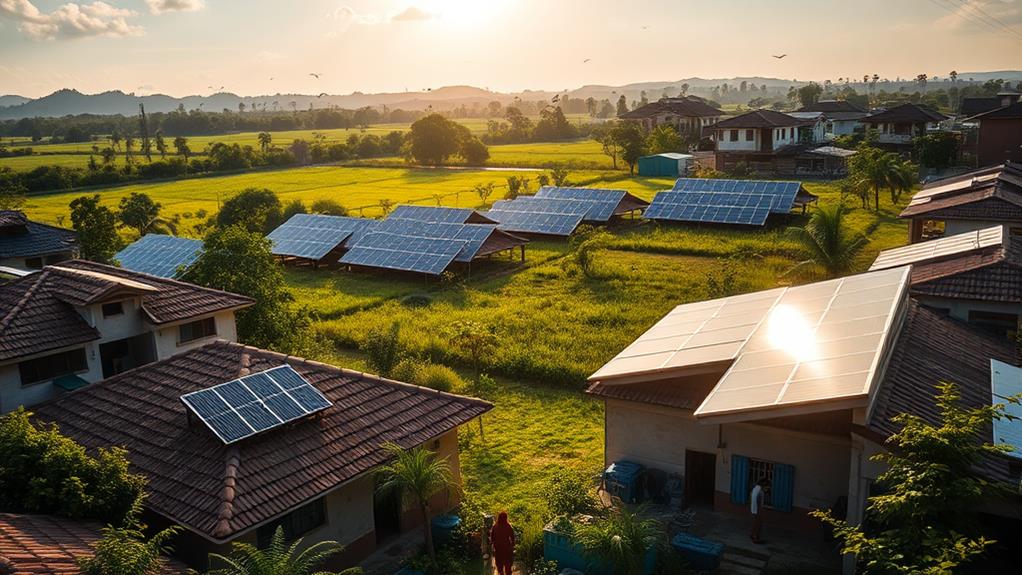
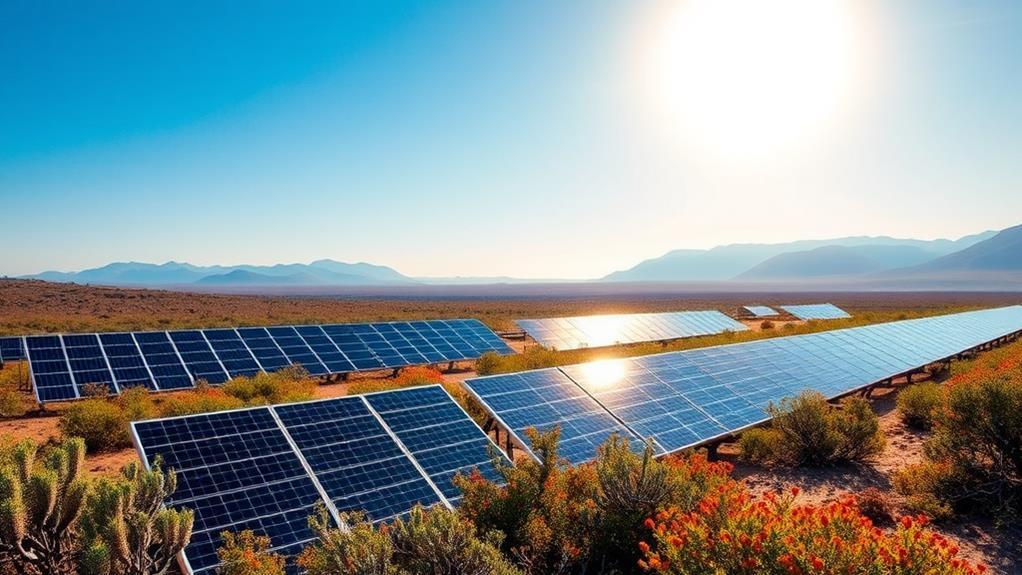
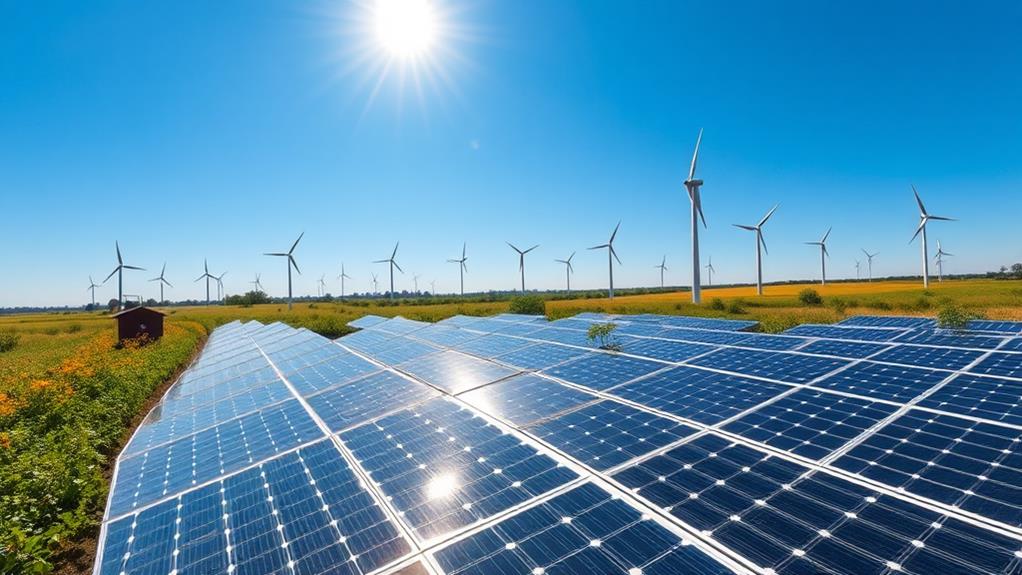
You’ll find ground mount systems using metal frames and mono-pole structures that handle uneven terrain with minimal preparation work. These ground-mounted options offer easier installation and maintenance compared to rooftop alternatives. Ground mount structures also provide flexible panel placement to maximise solar yield across large arrays.
Floating installations are gaining traction on reservoirs and dams, enhancing panel efficiency by 5-15% through natural water cooling.
Carport structures pull double duty—generating power while shielding vehicles from harsh UV exposure. These solutions are engineered with corrosion-resistant materials to withstand South Africa’s diverse climate conditions.
For maximum yield, tracking systems follow the sun’s path, producing 25-35% more energy than fixed alternatives.
Railless solutions cut component counts by 30%, speeding up installations considerably.
Roof-Mounted Solutions for Different South African Roof Profiles
When you’re planning a commercial solar installation, your roof profile dictates everything about the mounting approach.
South African buildings feature diverse roofing styles, and each requires specific hardware to guarantee secure, leak-free panel attachment.
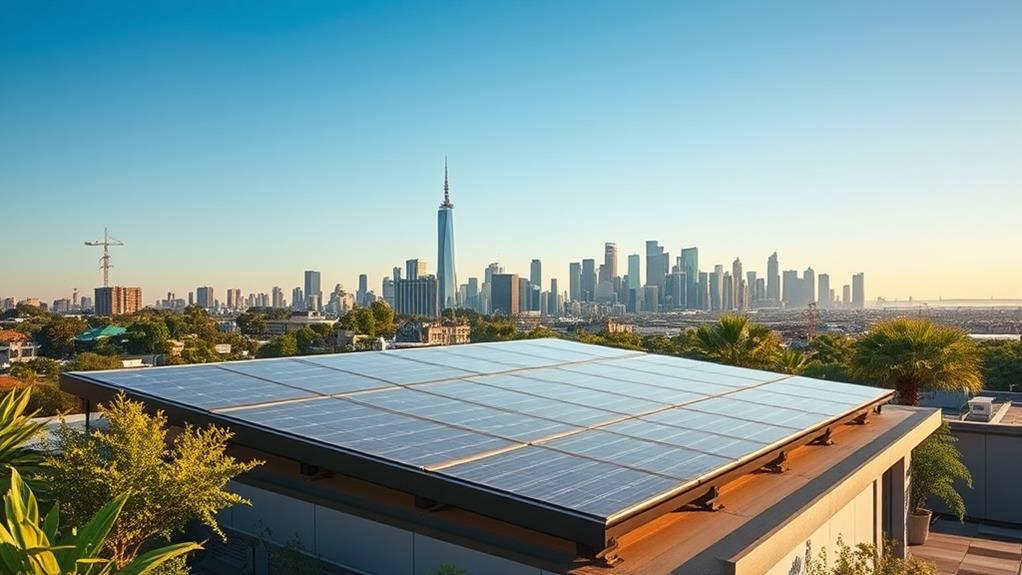
For IBR and corrugated metal roofs, you’ll find dedicated brackets that distribute loads across profile peaks without penetrating the surface.
Kliplok systems use specialised clamps that grip the trapezoidal seams securely.
Standing seam roofs benefit from clamp mechanisms that maintain watertight integrity while permitting tilt adjustments between 7° and 15°.
Tile roofs present unique challenges.
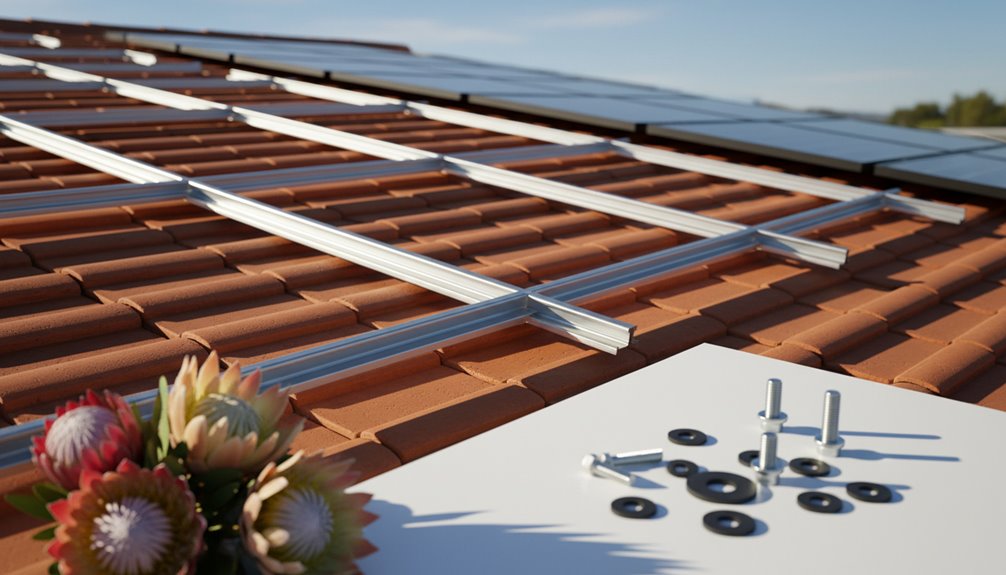
Solutions like adjustable roof hooks accommodate height variations up to 30mm while applying zero pressure on the tiles themselves.
These SABS-approved mounting systems are designed with input from South African roof manufacturers to ensure warranty compliance.
Flat concrete roofs typically use ballasted systems, eliminating penetrations entirely through calculated weight distribution that meets municipal building regulations. DeoSolar’s structural brackets provide non-conductive, corrosion-resistant solutions that prevent galvanic corrosion and ensure long-term performance across all roof types.
Ground Mounting System Options for Open Land Installations
Open land installations offer a different set of opportunities compared to rooftop systems.
Ground-based solar arrays unlock design freedom that rooftops simply cannot match—no structural limits, just open possibilities.
You have more flexibility with panel orientation, and you are not limited by existing roof angles or structural constraints.
Ground mount configurations come in several styles to match your site conditions:
- Single and double row systems work well for smaller arrays, while multi-panel structures scale up for commercial projects.
- Mono-pole mounting handles uneven terrain without extensive ground preparation.
- Ballasted systems use weight instead of ground penetration, perfect when you cannot dig into the soil.
These systems typically feature adjustable tilt angles at 20° or 25° to maximise your energy harvest based on South Africa’s latitude.
You will also find wind resistance ratings of up to 40 m/s, so they are built to handle local weather conditions.
The modular design of modern ground mounted systems allows for scalable solutions that can grow alongside your energy needs.
Materials and Durability Standards for South African Conditions
When you’re selecting mounting materials for South African conditions, you’ll need to weigh the trade-offs between aluminium and steel components carefully.
Aluminium profiles keep rooftop loads manageable while stainless steel delivers superior structural integrity for larger commercial systems, though it comes at a higher price point.
You’ll also want to factor in coastal corrosion protection and UV-resistant coatings, since South Africa’s intense sunlight and salty air can degrade substandard materials faster than you’d expect.
All Deo Solar mounting solutions are engineered with UV-stabilised, corrosion-resistant materials to ensure long-term performance in South Africa’s challenging environmental conditions.
Aluminium Versus Steel Components
Although solar panels rightfully steal the spotlight in any PV installation, the mounting components holding them in place determine whether your system thrives or fails under South Africa’s demanding conditions.
When choosing between aluminium and steel, you’ll need to weigh several factors:
- Weight considerations: Aluminium weighs roughly one-third of steel’s density, making it easier to handle and reducing roof load stress.
- Corrosion resistance: Aluminium naturally forms a protective oxide layer, while galvanised steel relies on zinc coating for protection.
- Cost differences: Galvanised steel costs 15-25% less upfront, but aluminium’s 25+ year lifespan often delivers better lifecycle value.
Steel brings superior tensile strength (505-860 MPa versus aluminium’s 70-700 MPa), making it ideal for high-wind zones under SANS 10160-3 requirements.
Your specific project conditions should ultimately guide your material choice.
Coastal Corrosion Protection
Material selection only gets you halfway to a reliable coastal installation.
You’ll also need proper certification and ongoing maintenance to protect your investment from South Africa’s harsh salt spray environments.
Your coastal mounting system should carry salt spray testing certification from recognised laboratories. SANS 10142-1 compliance isn’t optional—it’s mandatory for electrical safety in these zones.
Look for suppliers offering minimum 10-year warranties with specific anti-corrosion documentation.
Monthly visual inspections help you catch early corrosion at joints and connection points before they become expensive problems.
Annual professional inspections verify your mounting system’s structural integrity remains sound.
Here’s something worth noting: real-time monitoring systems have reduced coastal installation downtime by 40% through early corrosion detection.
That’s significant savings when you’re protecting a long-term solar investment.
UV-Resistant Coating Solutions
Because South Africa experiences some of the highest UV radiation levels on the planet, your mounting system’s coating technology matters just as much as the metal underneath.
Traditional coatings typically lose their effectiveness after just 2-3 years under our harsh sun. That’s why you’ll want to look for UV-stabilised formulations designed specifically for local conditions.
Here’s what quality UV-resistant coatings should deliver:
- Temperature resilience – withstanding extreme heat and thermal expansion cycles without cracking
- Long-term flexibility – maintaining integrity as materials expand and contract daily
- Weather resistance – protecting against dirt pickup while preserving reflective properties
The best mounting solutions use engineered composite materials with built-in UV stabilisation. This approach eliminates coating degradation concerns entirely, giving you confidence that your system will perform reliably for decades.
Fixed Vs Tracking Systems: Performance and Cost Comparison
When you’re assessing fixed versus tracking mounting systems for your South African solar project, the decision comes down to three key factors: how much energy you’ll generate, what you’ll pay upfront, and what ongoing maintenance looks like.
Tracking systems can enhance your daily energy production by 25-35% by pursuing the sun across the sky, but they’ll cost you 15-25% more initially and require regular motor and sensor upkeep.
Fixed mounting systems, on the other hand, offer simpler installation, fewer moving parts to maintain, and prove particularly cost-effective when you’re working with local manufacturers who comprehend South African conditions.
Energy Output Differences
Everyone evaluating solar mounting options eventually faces the same question: how much more energy will a tracking system actually produce compared to a fixed-tilt setup?
The numbers are intriguing. Single-axis trackers enhance energy generation by up to 25% in South African conditions. That’s a significant jump that directly impacts your project’s return on investment.
Here’s what you’re looking at:
- Fixed-tilt systems generate 15-20% less annual energy than single-axis trackers under identical conditions.
- Dual-axis systems push beyond that 25% threshold for even greater yields.
- Bifacial panels paired with tracking can add another 30% depending on ground reflectivity.
Tracking systems really shine during early morning and late afternoon hours when fixed installations struggle with reduced output.
You’re capturing energy that fixed systems simply miss.
Cost-Benefit Analysis
While those energy gains look impressive on paper, the real question comes down to whether the extra kilowatt-hours justify the higher price tag.
You’ll pay a 20-25% premium for single-axis tracking over fixed systems, and dual-axis pushes that to 40-50% more. That’s before factoring in motorised components running between R55,000 and R180,000.
Here’s where it gets interesting. Fixed systems hit payback in 4.3-4.8 years, while tracking extends that timeline by 6-12 months.
But over 20 years, tracking systems can deliver R575,000-R775,000 in profit compared to fixed systems’ R498,000-R621,000.
There’s a catch, though. Tracking components need replacement after 10-12 years, while fixed mounts last 15+ years.
You’ll need to budget for that mechanical refresh halfway through your system’s life.
Maintenance Requirements Compared
Because tracking systems rely on motors, gears, and sensors to follow the sun, they demand considerably more hands-on attention than their stationary counterparts.
You’ll need monthly mechanical checks, quarterly motor calibrations, and regular lubrication to keep everything running smoothly.
Fixed tilt systems, on the other hand, keep things simple.
With no moving parts, you’re looking at visual inspections just twice a year.
Here’s what maintenance typically involves for each:
- Fixed tilt: Bolt and bracket integrity checks, occasional cleaning
- Single-axis trackers: Motor functionality tests, sensor cleaning, alignment recalibration
- Dual-axis trackers: All of the above, plus more frequent component inspections
When tracking maintenance falls behind, you could see efficiency drop by up to 15%.
Fixed systems maintain steadier performance with far less effort on your part.
Key Factors to Consider When Selecting Your Mounting System
Selecting the right mounting system for your solar installation involves balancing five critical factors: structural compatibility, environmental conditions, spatial constraints, material quality, and installation requirements.
Your roof type determines which brackets you’ll need. Metal roofs like IBR or corrugated require different solutions than concrete tiles. You’ll also want to verify that your structure can handle the combined weight of panels plus wind and weather loads.
| Factor | What to Check |
|---|---|
| Structural | Roof type, load capacity, pitch angle |
| Environmental | Wind zone, corrosion exposure, UV levels |
| Spatial | Orientation, shading, expansion room |
| Compliance | COC requirements, municipal permits |
Don’t forget about maintenance access. You’ll need clear pathways for cleaning and future repairs. Getting these factors right from the start saves headaches later.
Leading Solar Mounting Providers in South Africa
South Africa’s solar mounting market features several established manufacturers, each bringing distinct strengths to commercial and industrial projects. You’ll find companies with decades of experience alongside newer players who’ve quickly made their mark.
When evaluating providers, consider these standout options:
- Deo Solar – Based in Pretoria, they manufacture rail-less composite brackets locally, facilitating faster installations and reduced labour costs for IBR, corrugated, and Klip-lok roofs.
- Axe Struct – Established in 2018, they offer a 10-year guarantee against structural failure across their locally manufactured range.
- Clenergy – Operating since 2007, they’ve supported 20 GW of installations globally and maintain extensive installer support throughout South Africa.
Each provider offers different advantages, from lightweight steel systems to pre-punched kits designed specifically for local conditions.
Your project requirements will fundamentally guide the best choice.
Installation Requirements and Structural Assessment Guidelines
Choosing the right mounting provider matters, but the success of your installation hinges on what happens before a single bracket touches your roof.
First, you’ll need a structural integrity evaluation. Your roof must handle the weight of the panels plus wind resistance—this isn’t optional. For cement tiles or corrugated iron, you’re looking at manufacturer-specific mounting solutions.
Got a flat roof? You’ll need tilt frames to catch proper sun exposure.
Roof slope plays an essential role too. If yours sits between 20° and 30°, you can mount panels flush against the surface. This approach looks cleaner, costs less, and stands up better to the weather.
Don’t skip the permits either. Building permits assess load-bearing capacity, while electrical permits verify compliance with SANS 10142-1.
You’ll submit detailed plans showing system design and structural specifications before any work begins.